
A low garden wall can look like the beginning of a seat. Its top, however, does not establish a comfortable sitting position or provide a useful backrest. Adding timber later may leave the sitter too high, too far from support or facing a part of the garden they rarely want to watch.
In a Condell Park renovation, we would develop fixed outdoor seating as a small piece of architecture. The seat, its support and its position should be considered while the house and garden can still respond. A movable chair remains a useful alternative where that commitment has not earned its place.
Design the sitting position before the wall
Begin with the people who will use the seat and how they expect to sit. A brief pause beside the garden has different demands from reading for an hour. Try a suitable chair or a full-size mock-up to establish the relationship between the seat, back, feet and arms before turning those relationships into masonry and joinery.
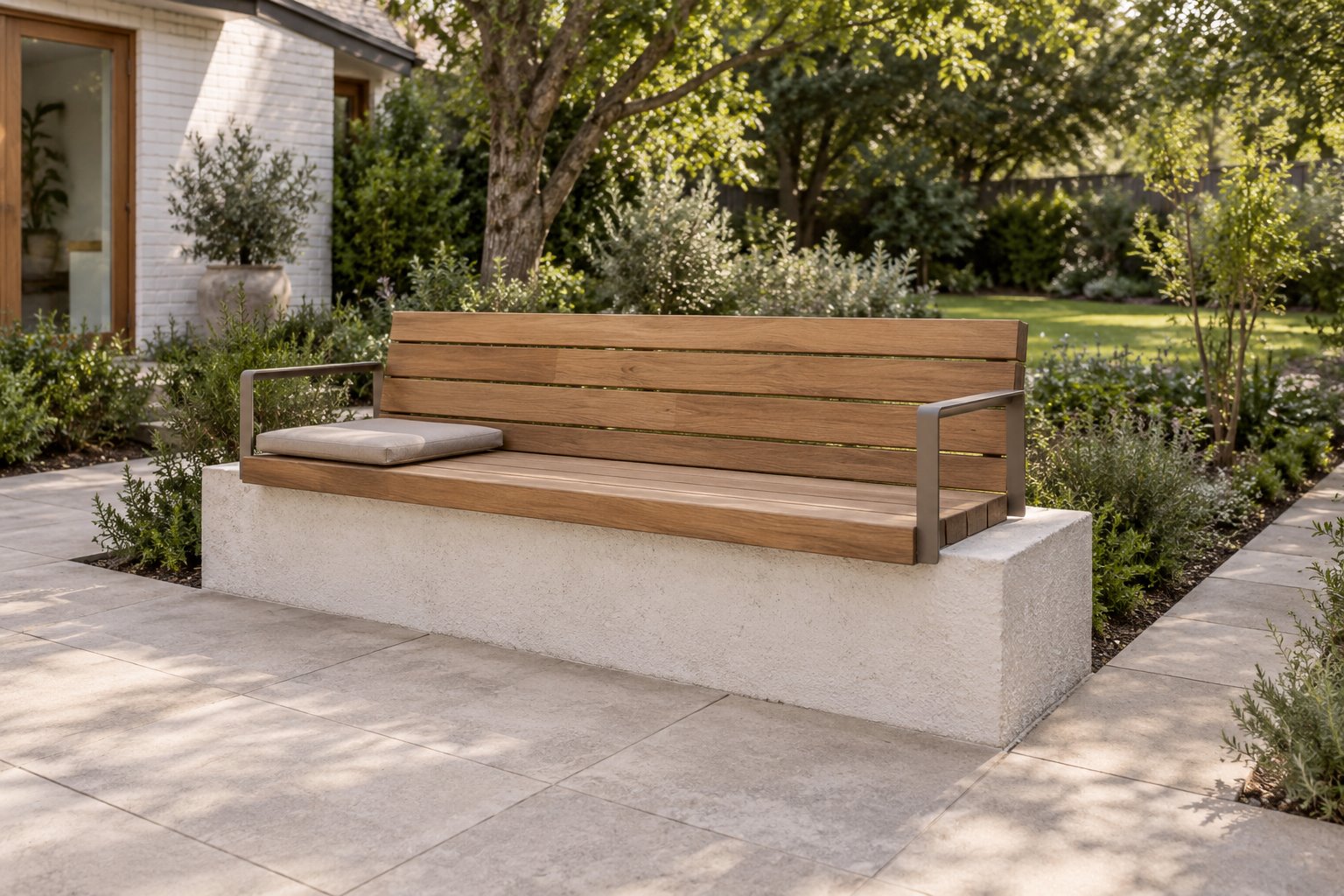
Draw a section through the actual finished seat. Include any cushion that will normally be used, the front edge beneath the legs and the backrest behind the shoulders. A generous horizontal slab is not equivalent to a supportive seat. A timber back can also need its own frame rather than being attached casually to an unrelated garden wall.
Consider an armrest for support and a place to stand beside the seat, according to the household’s needs. Particular mobility requirements need an appropriate access study of the approach and seating together. A bench with arms does not by itself demonstrate accessible use.
Street Furniture Australia’s published seat options distinguish backrests, arms and different mounting arrangements. That is a useful reminder to resolve these as connected parts. A domestic seat can be quieter and more particular to the garden than a public product, while still needing a complete design.
Choose what the seated person will experience
Condell Park’s small-village-centre chapter describes everyday shopping alongside opportunities to stop for coffee and conversation. Council’s December 2023 Condell Park Nook proposal similarly brought seating, shade and planting into one public-space concept. The consultation page is a proposal record; it does not establish that the work has been completed.
For a private garden, the useful lesson is to study the seat with its surroundings. Look from the proposed sitting height towards the planting, house openings and neighbouring windows. A place that looks attractive from the kitchen may face straight back into it, or put the sitter uncomfortably close to a frequently used door.
Observe when the place receives sun and shade, including the season and time it is most likely to be occupied. A fixed seat cannot follow a moving patch of shelter. Test the position with movable furniture before committing to the base, and consider whether a different orientation or a separate chair gives a better range of choices.
Keep planted ground part of that study. The current residential chapter seeks usable outdoor space, sunlight, privacy and landscape provision in its relevant dwelling-house and dual-occupancy sections. At the actual address, assess the applicable controls and the whole garden; a new seat should not turn the remaining growing area into paving merely to give it a formal setting.
Decide how the seat meets the ground
Compare a seat on its own supports with one carried by a dedicated low plinth. The first may leave the ground and underside more open. The second can give the garden a definite edge, but it commits more material and needs a suitable foundation. Neither should be assumed to work by fastening it to an existing wall of unknown construction.
Have the support and fixing arrangement designed for the actual ground and seat. Record nearby trees, roots, services and existing paving before locating new foundations. If a wall also retains soil or performs another structural job, that is a separate condition to assess rather than an opportunity to add a seat without investigation.
Show the occupied seat in the garden plan, with feet and the approach beside it. Preserve an ordinary walking route when someone is sitting down. Resolve the paving and planted levels so water, damp soil and fallen leaves do not become trapped against the timber or its supports. The designer should coordinate that junction with the seat maker and relevant construction advice.
Keep the permanent seat serviceable
Choose timber, metal and mineral surfaces with their actual exposure and care requirements understood. Street Furniture Australia’s November 2025 maintenance guide distinguishes material care, sheltered surfaces and periodic fixing inspections. The architectural consequence is to leave the relevant edges reachable, including behind and beneath the seat, rather than conceal every connection for a seamless photograph.
Ask how a damaged batten, worn finish or loose fitting will be dealt with under the selected maker’s instructions. Allow for any removable cushion to be stored dry. A seat that can be maintained in place may be a better long-term choice than a heavier composition whose wearing parts cannot be reached.
For an extension or new home, establish the garden seat while arranging the adjacent room and outdoor ground. For a retained Condell Park home, bring benssur the garden plan, photographs and a description of where you actually like to sit. We can compare a modest fixed seat with a movable arrangement as part of a useful house and garden renovation.
Further reading
- Canterbury-Bankstown — current development control plan
- Council — Condell Park small village centre, pages 26–27
- Council — Condell Park Nook proposal, December 2023
- Council — current residential design objectives
- Street Furniture Australia — complete seat and mounting options
- Street Furniture Australia — November 2025 maintenance guide
Start a conversation
Planning a home project?
Tell us the site, project type and the main decision you need help with.
No prepared brief is required.