
Key point
Test meaningful alternatives, compare them fairly and stop when a well-reasoned option satisfactorily meets the real brief.
A House Is An Ill-Structured Decision
A residential brief begins incomplete. The client knows important needs, but the site, approvals, structure, budget and design possibilities introduce information that cannot all be known at once. There is rarely a single test that proves one home is optimal. Treating the first sketch as the answer hides this condition. Testing options is a disciplined way to represent the problem, learn from alternatives and select a satisfactory direction with the evidence available.
Search Enough To Challenge The First Idea
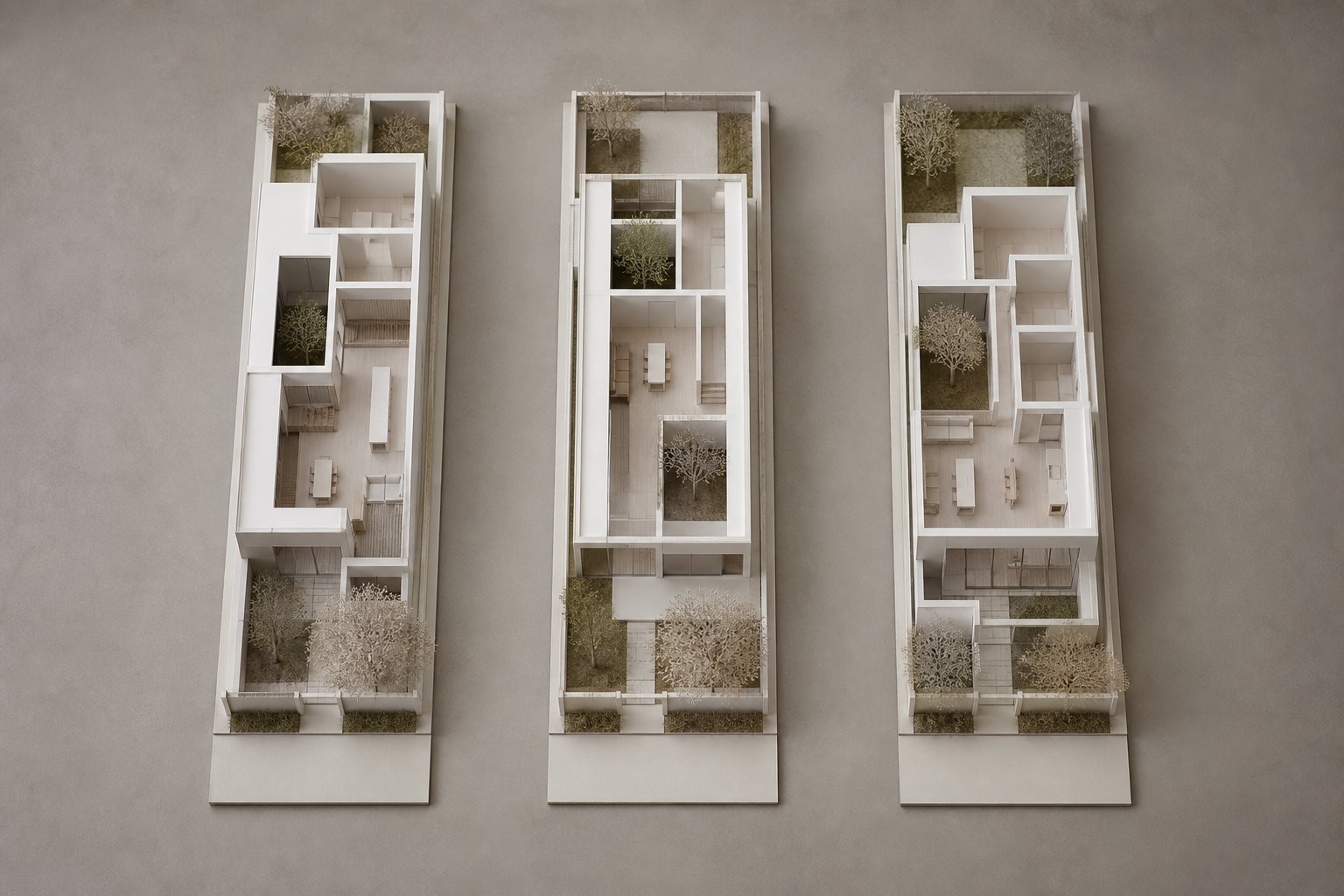
The aim is not to produce variations for display. Each option should test a meaningful question: build up or out, retain or replace, open or protect, centralise or separate, enlarge or reorganise. A small set of distinct alternatives often reveals more than many cosmetic changes. Search remains bounded by time and resources, so the architect uses judgement to explore the possibilities most likely to affect the brief, constraints and long-term performance.
Compare Every Option With The Same Criteria
Use consistent criteria such as daily function, daylight, privacy, garden, access, planning, structure, energy, maintenance, disruption and budget. Give more weight to the values that matter most to the household. A comparison table, diagrams or model can make differences visible, but they do not replace architectural judgement. They stop one appealing image from being assessed on beauty while another is judged on cost, and they give the client a fairer basis for choice.
Let Evidence Inform Taste
Architecture still involves preference, atmosphere and composition. Evidence should not flatten those qualities into a formula. It can show where winter light reaches, how a neighbour sees a window, what structure a large opening needs or how circulation changes between options. The client and architect can then make a value choice with a clearer understanding of consequences. Every major decision has a reason, but that reason may combine facts, professional judgement and the household's priorities.
Use A Hypothetical Courtyard Test
Imagine a hypothetical home where the first idea places a courtyard at the centre. One option may bring light deep inside but reduce a continuous garden. Another may move the courtyard to an edge, improving outdoor area while changing privacy and circulation. Neither is automatically best. Drawing both and testing sun, views, movement, structure and cost helps the household understand which trade-offs it prefers. The example shows the method, not a template for every site.
Stop When The Choice Is Satisfactory
Option testing needs a stopping rule. Continue while a major criterion is unresolved, an important alternative has not been examined or new evidence changes the problem. Stop when a direction meets the essential brief, responds credibly to constraints and has trade-offs the client understands and accepts. This is satisficing rather than claiming perfection. It respects the reality that more search consumes time and may not improve the decision enough to justify continued exploration.
Keep The Reasoning Through Later Stages
Record why the preferred option was selected and what assumptions support it. Planning advice, engineering, cost checks or builder input may later challenge those assumptions. The decision record allows the team to revise intelligently rather than defend an obsolete concept or make disconnected changes. Testing options is therefore not a one-time presentation technique. It establishes a learning process in which the design adapts while the client's main goals and accepted trade-offs remain visible.
Sources and further reading
Start a conversation
Planning a home project?
Tell us the site, project type and the main decision you need help with.
No prepared brief is required.