
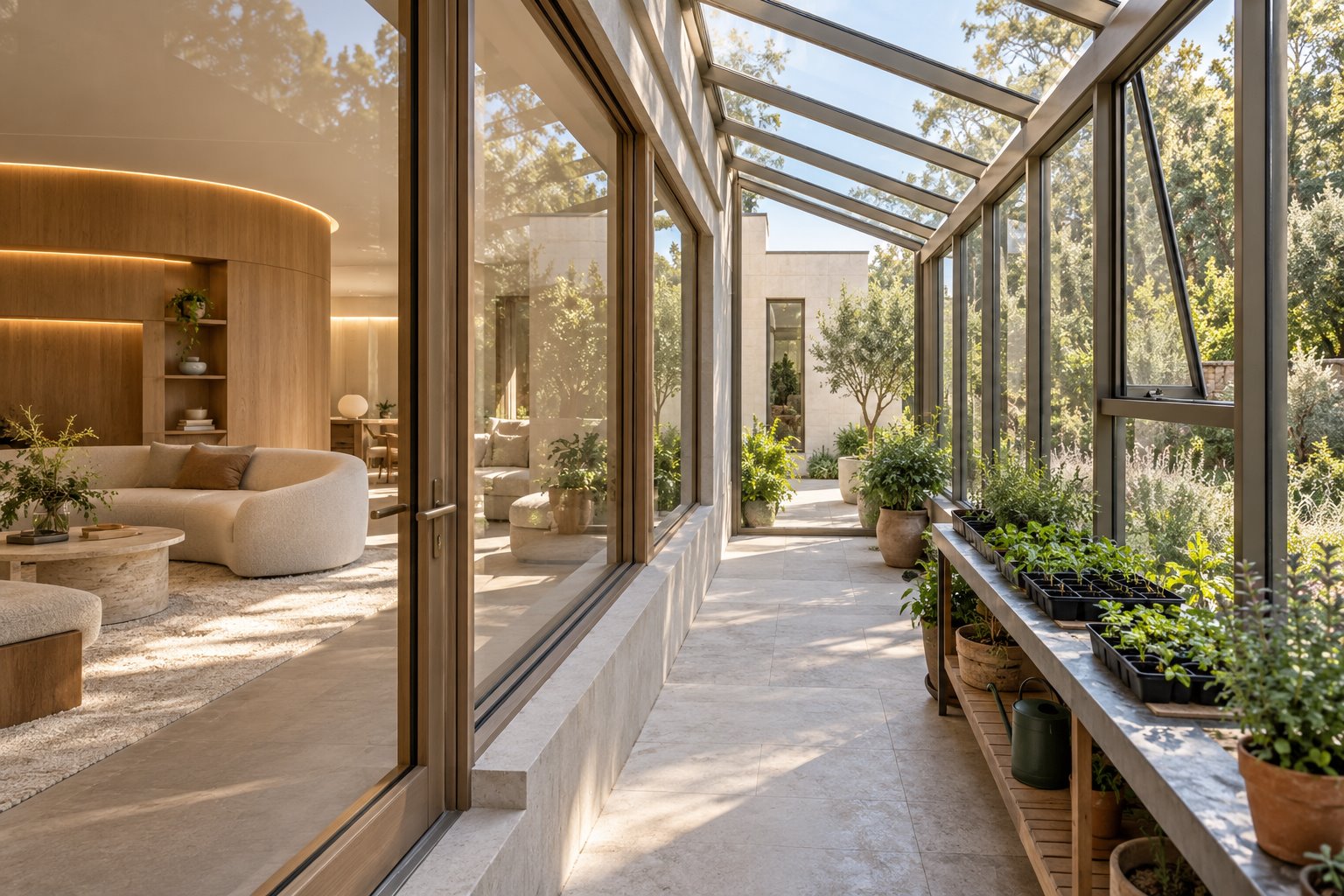
A glasshouse beside the living room can make tending plants part of daily life. It can also put a working space between the room and the garden, changing the view, the light and the journey outside. For a Hurstbridge renovation, extension or new home, benssur would decide whether those two spaces belong together before drawing an extra glazed enclosure.
Renew’s Urban earth house describes a Hurstbridge home designed by Craig Byatt with a north-side glasshouse. The 2020 account by Sophie Weiner explains that it supports vegetable growing and seed propagation. This is one household’s purposeful arrangement, not a feature of Hurstbridge homes generally. For another owner who enjoys growing plants, the useful question is what the adjoining living room would gain and what it would give up.
Two spaces need two workable plans
Draw the growing benches and the living-room furniture at the same time. A space wide enough for trays may still be too narrow to work in comfortably or carry a pot through. Making it wider can improve the gardening task while placing the garden farther from the sofa and taking land that might otherwise serve an outdoor sitting area.
The living room needs an outlook that works when the growing space is busy, not just when it has been tidied for a photograph. Benches, pots and stored supplies will become part of that foreground. If seeing the work in progress is enjoyable, the connection can feel personal. If the household wants an uncluttered view, putting the growing area beside rather than across the main window may be more useful.
Doors deserve the same attention. A route to the garden that passes through the growing space can make plant care convenient, but every visitor or basket of washing then travels through it too. A separate garden door preserves a direct route from the house while using another part of the wall and potentially changing furniture positions.
Compare attachment with a separate greenhouse
An attached space can be reached without a separate walk through the garden. It brings the activity close to the house and may be appealing for someone who tends plants several times a day. It also adds another enclosure to maintain and changes the conditions beside the existing windows and doors.
A detached greenhouse lets the living room keep a direct garden edge and allows its own position to be chosen for growing. The compromise is a separate trip outside and another building within the garden. Its access, footprint and relationship to neighbours still need to be designed; moving it away from the house does not make those questions disappear.
There is a simpler option for a modest growing brief: retain the living room and improve the outdoor working area instead. A sheltered potting place may meet the actual need without enclosing the garden edge. It will not provide the same growing conditions as a greenhouse, so the choice starts with what the household intends to grow and how often it wants to work there.
Do not count the same space twice
A glazed growing area should not be assumed to provide the all-season living room the house lacks. Comfort, ventilation, shade, moisture and the connection between enclosures require project-specific design and assessment. The Your Home passive-heating guidance also cautions that excessive glazing can create substantial heat gains and losses. A sunny appearance is not a performance assessment.
In a renovation, keeping the existing room’s openings operable and accessible may be more important than maximising planting benches. In an extension or new house, the two spaces can have deliberate edges: a comfortable seat inside, a useful working strip beyond and doors that can be reached without moving equipment. Warm joinery can give the living room a calm backdrop while the growing space remains honestly practical.
An attached enclosure, a separate greenhouse and a simpler garden connection remain options for your project with benssur. Start with the growing activity you want close to home, then decide how much of the living room’s garden edge it should occupy.
Start a conversation
Planning a home project?
Tell us the site, project type and the main decision you need help with.
No prepared brief is required.